

Families of 16 to 18-year-olds with SEND could pay £795 for council transport from September 2027. Nottinghamshire's consultation closes on 4 January.
Families of 16 to 18-year-olds with special educational needs and disabilities (SEND) could be asked to pay £795 towards council-arranged transport to school or college from September 2027. Nottinghamshire County Council has put four options out to consultation, and every one of them includes that charge.
The consultation closes on Monday 4 January 2027. The county runs SEND transport for the whole of Rushcliffe, including West Bridgford, Bingham, Keyworth and East Leake. (Nottinghamshire County Council, consultation page)
Why the council wants to change it
The council says demand for organised SEND transport has almost doubled in five years. Travel help for children and young people with SEND is expected to cost about £29 million this year, rising to £35 million within two years.
For post-16 learners, the council’s figures for the three kinds of help it offers now are:
| Support | What it is | Average cost to the council per student a year |
|---|---|---|
| Organised transport | A taxi, minibus or specialist vehicle | £11,000 |
| Direct Travel Assistance Payment (DTAP) | An upfront payment for the family to arrange travel | about £2,500 |
| Parent or carer mileage | A lower payment for fuel only | about £1,250 |
Council-arranged transport for 16 to 25-year-olds costs about £7 million a year, according to its announcement of the consultation.
The four options
The £795 is equivalent to 7% of the cost of the transport. The council says it matches the contribution it proposes for a council bus pass on mainstream school transport from September 2027. Households with an income below £7,400 would not be charged. Learners aged 19 to 25 would not pay, because the law requires their transport to be free where the council decides it is necessary.
- Option 1, contribution only. Organised transport stays available to eligible learners aged 16 to 25. Families of 16 to 18-year-olds pay the £795. Estimated saving: £0.4 million.
- Option 2, a new test for Year 12 from 2027. Learners already on organised transport keep it until they finish post-16 education. From September 2027, a young person starting Year 12 gets organised transport only in “exceptional circumstances”, shown through an enhanced assessment. Plus the £795. Estimated saving: £1.5 million.
- Option 3, the test for all post-16 learners from 2028. From September 2028 every family with a young person in or entering post-16 education has to apply again, and organised transport goes only to those who pass the enhanced assessment. Plus the £795 from 2027. Estimated saving: £2.3 million.
- Option 4, the test for all post-16 learners from 2027. As option 3, a year earlier. Estimated saving: £3.1 million.
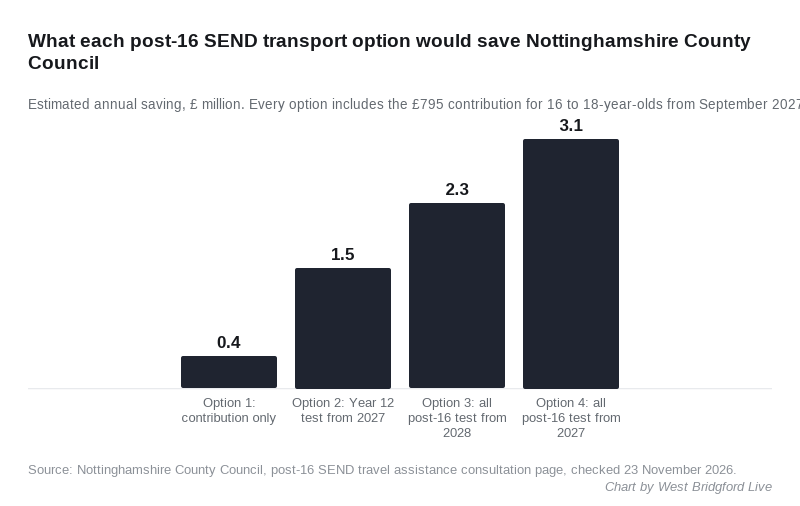
The council says its SEND travel costs are still forecast to rise by at least £2 million over the next two years under any of the four.
Where a family does not pass the test, or chooses not to take it, the council would offer a DTAP. From September 2027 it would be worked out at 55p a mile, for four journeys a day over up to 190 school days, or 160 college days. The council estimates a family with a young person in full-time education would get an average of £3,000 a year, loaded each term onto a prepaid card.
What counts as exceptional
The council proposes that exceptional circumstances apply when, after an individual assessment, it decides organised transport is necessary for the young person to attend. It would look at the young person’s SEND, medical needs, the journey and the family’s circumstances, and whether a DTAP, mileage or any other arrangement would be “reasonable and practical”. It says no single factor would settle it.
Councillor Bert Bingham, the county’s cabinet member for transport and environment, said: “We would like to reassure families, young people and schools that no decisions have been made at this stage.”
What it means for you
- If your child is 16 to 18 and uses a council taxi or minibus, all four options would mean a £795 charge from September 2027 unless your household income is under £7,400.
- If your child is in Year 10 or 11 now, options 2 and 4 would apply the new test when they start Year 12 in September 2027.
- If your child already has organised transport, option 2 lets them keep it. Options 3 and 4 would mean a new application and assessment.
- You can respond more than once. The council asks parents and carers to fill in the survey for each young person who could be affected.
How to have your say
- online, on the council’s consultation hub
- by post, using the printable surveys on the consultation page, to Post-16 SEND Travel Review, PO Box 1889, County Hall, Loughborough Road, West Bridgford, NG2 7QP
- by phone: call 0300 500 80 80 and ask for a call back, and someone will fill in the survey with you
- at any Nottinghamshire library, including West Bridgford’s, where staff can print a copy
Easy read versions are on the consultation page. The council is running two online webinars, on Wednesday 25 November, 6pm to 7pm and Thursday 10 December, 10am to 11am, with booking links on the same page.
When it announced the consultation, the council described it as running for eight weeks from 20 October. Its consultation page now gives 4 January 2027 as the closing date.
Have your say
Nick 25 November 2026
As a parent of someone with severe learning disability, I understand that money is tight, and don't mind having to pay the £795. However, these proposals also contain vaguely specified "exceptional circumstances" without which there'll be no provided transport. Our family is already stretched to the limit trying to cope with our son's disability. It's likely that us and other families would be pushed over the edge if we lose the provided transport. It hastens the day when, against our wishes, we'd have to give up and tell the council we can no longer look after him and they'll have to provide residential care. It only takes a minority of the 800 affected families to reach this point when any savings on transport are dwarfed by extra costs in social care. This is a lose-lose situation the council are proposing, not only a disaster for families but not financially prudent by the council and a terrible deal for the taxpayer.